Cameron Long · 28 October 2026
Shifting Harvest Seasons Force Adjustments in School-Based Environmental Programs
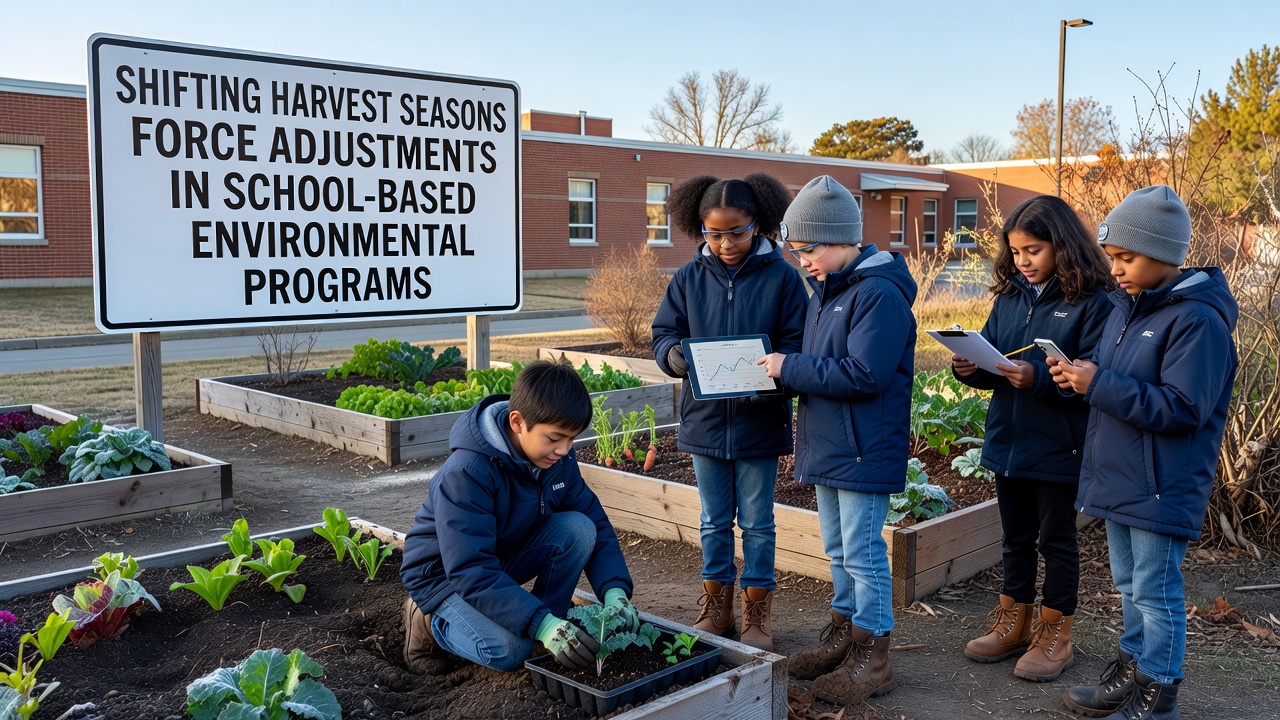
Harvest seasons have shifted earlier across many agricultural regions, and school-based environmental programs now face direct pressure to realign their calendars, crop selections, and outdoor activities. Data from the U.S. Department of Agriculture show average harvest dates for staple crops advancing by seven to fourteen days in the past two decades, while European Environment Agency records indicate similar advances in wheat and vegetable yields across central member states. Schools that once timed garden projects around traditional autumn peaks must now compress or relocate modules to match these new windows.
Observed Changes in Growing Cycles
Researchers at the University of Melbourne documented a consistent ten-day advance in grain harvest dates between 2000 and 2025 across southeastern Australia, and Canadian agricultural reports confirm comparable movement in prairie provinces. These compressed cycles leave fewer weeks for student-led planting, monitoring, and harvest events that previously spanned September through late October. In October 2026 several districts in the American Midwest began piloting shortened outdoor lab sessions that conclude by mid-September to capture peak ripeness before earlier frosts or heat stress sets in.
Program Adaptations Underway
Schools have responded by introducing staggered planting dates, drought-tolerant varieties, and indoor hydroponic units that extend learning opportunities beyond field conditions. Curriculum coordinators in Ontario, working with Agriculture and Agri-Food Canada guidelines, now schedule half of their environmental modules indoors during the final weeks of the traditional season, while Australian programs coordinated through the Commonwealth Scientific and Industrial Research Organisation have added remote-sensor data units so students can track soil moisture and yield forecasts in real time. These adjustments preserve core learning objectives even when outdoor windows close sooner than expected.
Observers note that transportation logistics also require recalibration. Bus schedules for farm visits once aligned with late-September harvest festivals now compete with earlier commercial operations, prompting some districts to secure earlier permits and coordinate with local growers who finish field work weeks ahead of prior norms. Data from the Food and Agriculture Organization of the United Nations indicate that regions experiencing the largest seasonal advances have seen the highest number of such schedule revisions in public education settings.
Examples from Multiple Regions
Take one district in northern California where educators replaced a single large autumn harvest day with three smaller spring-to-summer checkpoints using faster-maturing bean and squash cultivars. Students still collect full datasets on growth rates, yet the program finishes before the earliest heat events that now arrive in early fall. In the United Kingdom, programs supported by the Department for Environment, Food and Rural Affairs have integrated citizen-science apps that allow classes to upload phenology observations year-round, reducing reliance on any single harvest window. Similar approaches appear in New Zealand, where the Ministry for Primary Industries funds teacher training on climate-adjusted planting calendars.
Resource and Training Implications
Teacher professional development has expanded to cover new crop varieties and data interpretation tools. Workshops offered through university extension services in both North America and Europe now include modules on interpreting seasonal forecast bulletins issued by national meteorological agencies. Budget lines previously allocated for October field trips have shifted toward seed purchases timed for earlier spring sowing and toward digital platforms that maintain continuity when weather windows close abruptly.
What's notable is how these changes intersect with existing academic calendars. Many secondary schools report moving environmental science units from the fall semester into the spring to align with revised planting dates, while elementary programs have lengthened summer garden clubs that continue under parent or community supervision. Figures from the National Center for Education Statistics reveal a measurable uptick in such calendar adjustments between 2023 and 2026, coinciding with published harvest-date trends from multiple national agricultural departments.
Looking Ahead
Longer-term planning now incorporates climate-projection models from the Intergovernmental Panel on Climate Change and national meteorological services to anticipate further compression of outdoor seasons. Districts that maintain active partnerships with regional growers gain early notice of harvest timing, allowing curriculum teams to pre-schedule student involvement before commercial crews begin work. Continued monitoring through standardized phenology networks will supply the data needed to keep school programs synchronized with actual field conditions rather than historical averages.
Conclusion
Shifting harvest seasons have prompted measurable revisions to the timing, location, and format of school-based environmental programs across multiple continents. Government data sets, university extension records, and intergovernmental reports all document earlier crop maturity windows that require educators to compress or relocate activities while preserving core learning outcomes. Programs that adopt flexible calendars, new crop selections, and digital monitoring tools demonstrate how institutions can maintain continuity even as agricultural timelines continue to evolve.